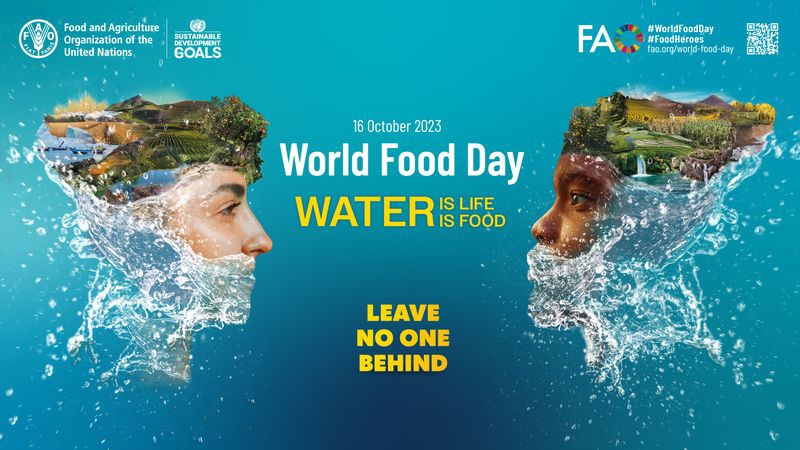
Water is essential to life on Earth. It covers the majority of the Earth’s surface, makes up over 50% of our bodies, produces our food, and supports livelihoods.
But this precious resource is not infinite and we need to stop taking it for granted. What we eat, and how that food is produced all affects water.
Together, we can take water action for food and be the change.
FACT:
1. 95% of our food is produced on land and all begins with soil and water.
2. Agriculture accounts for 72% of global freshwater withdrawals, while 16% is used by industries, and 12% by municipalities for households and services.
3. Currently 2.4 billion people live in water-stressed countries, and approximately 10% of the global population live in countries with high and critical water stress.
4. Global water demand for agriculture is expected to increase by 35% by 2050.
5. Over 80% of the world’s wastewater is released to the environment without being treated.
6. Around 74% of all disasters from 2001-2018 were water-related, causing almost USD 700 billion in economic damage.
7. Since 2000, flood-related disasters have increased by 134%, and the number and duration of droughts increased by 29%.
8. Wetlands – the most biologically diverse of all ecosystems – are disappearing three times faster than forests, and 85% have been lost over the past 300 years.
9. Limiting global warming to 1.5°C, compared to 2°C, will benefit water resources and reduce water stress induced by climate change.
10. Around 600 million people depend, at least partially, on aquatic food systems for a living.
11. Almost 1 billion tonnes of food – 17% of all food available to consumers worldwide – is thrown away each year, resulting in the waste of precious resources, such as water, that were used to produce it.
It’s time to start managing water wisely
We need to produce more food and other essential agricultural commodities with less water, while ensuring water is distributed equally, our aquatic food systems are preserved, and nobody is left behind.
Governments need to design science and evidence-based policies that capitalize on data, innovation and cross-sectoral coordination to better plan and manage water. They need to support these policies with increased investment, legislation, technologies and capacity development, while incentivizing farmers and the private sector to engage in integrated solutions for a more efficient use of water, and for its conservation.
What can you do?
We all need to stop taking water for granted and start improving the way we use it in our daily lives. What we eat, and how that food is produced all affect water. We can make a difference by choosing local, seasonal, and fresh foods, wasting less of it – even by reducing food waste, and finding safe ways to reuse it while preventing water pollution.
Together, we can take water action for the future of food, people, and the planet
Water as a livelihood
Water covers 71% of our planet’s surface. From oceans to lakes, rivers and estuaries, water bodies are home to flourishing ecosystems, hosting important habitats and a surprising wealth of biodiversity.
Over 600 million people depend on aquatic food systems for a living including small-scale fishers, fish farmers, fish processors, as well as their dependents. They are the backbone of coastal and inland communities, supporting local economies and influencing cultures worldwide.
Currently, we exploit almost 3 000 species in capture fisheries, and we cultivate over 650 of these species.

The diversity of aquatic food systems makes them a unique and essential source of nutrition and food security. Aquatic foods are increasingly recognized for their potential to combat malnutrition, due to rich essential nutrients such as omega-3 fatty acids, vitamins, and minerals that are vital for human health.
Preserving and safeguarding these aquatic ecosystems and the species they support is not just a responsibility, but a necessity for the well-being of our planet and its inhabitants.
Governments, the private sector, farmers, academia, civil society and individuals need to work together to address water challenges. We need to produce more food, fiber, animal feed and biofuel with less water, while ensuring water is distributed equally, our aquatic food systems are safeguarded, and nobody is left behind.
Every one of us, including youth, can take water action for the future of food, people, and the planet.
Source : http://www.fao.org
 Lobbyist Agency